
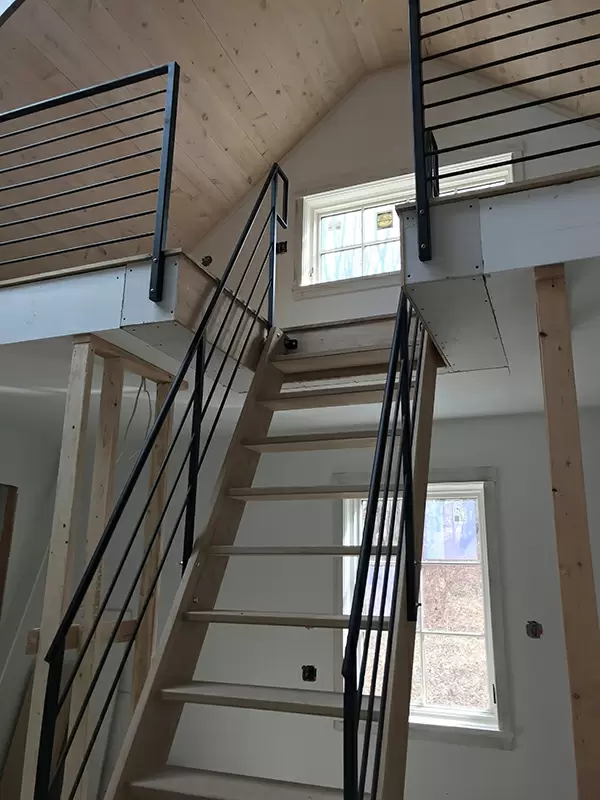
A ships ladder can look deceptively simple. At first glance, it is little more than a steep run of steps with handrails, but small changes in proportion can make a major difference to how comfortably and safely it can be used. In ships ladder design, dimensions are not simply a matter of fitting the ladder into the available gap; they affect balance, footing, body position and the ease with which someone can move between levels.
The angle of the ladder is one of the first things to consider. Ships ladders are generally steeper than conventional stairs, which is what allows them to work in areas where floor space is limited. However, increasing the angle too far can make the ladder feel more like a vertical access ladder than a staircase. A well-planned angle should provide the space-saving advantage without making ascent or descent unnecessarily awkward.
Tread depth plays an equally important role. Because users are approaching each step at a steeper angle, they need enough surface area to place their feet securely. Very narrow treads can encourage users to climb more cautiously or turn their feet sideways, particularly when descending. The shape, surface and spacing of the treads can therefore have as much influence on usability as the overall dimensions of the ladder.
Rise is another measurement that deserves careful attention. This is the vertical distance between consecutive treads. If the rise is inconsistent, even by a relatively small amount, the ladder can feel surprisingly uncomfortable to use. People naturally develop a rhythm when climbing, and an unexpected change in step height can interrupt that rhythm and increase the chance of a misstep.
Width also matters, although simply making a ships ladder wider does not automatically make it better. The available space, intended users and surrounding structure all need to be considered. A ladder used occasionally for maintenance access may have different requirements from one that forms a regular route between working levels.
Handrail positioning is sometimes treated as a secondary detail, but it is closely connected to the ladder’s overall dimensions. Users should be able to grip the rails naturally while climbing without having to reach excessively or twist their body. On a steep ladder, reliable hand support becomes particularly important during descent.
The space at the top and bottom of the ladder should not be forgotten either. A technically well-proportioned ladder can still be awkward if users have little room to step on or off it. Clear landing areas allow people to transition safely between the ladder and the surrounding floor or platform.
Dimensions also need to work together rather than being considered separately. A steeper angle may require different tread proportions, while changes to ladder width can affect handrail positioning. Adjusting one measurement can therefore influence several other parts of the design.
A successful ships ladder is ultimately the result of proportion rather than any single measurement. When angle, tread depth, rise, width, handrails and landing space are considered together, the finished structure can provide compact access without sacrificing practicality.